
“I ordered a canvas print online because the photos looked beautiful, the website claimed museum quality, and the price seemed too good to pass up. When it arrived, the colours looked dull, the canvas felt plastic-like, and the whole thing seemed cheaper than I expected.”
Unfortunately, this story is becoming increasingly common.
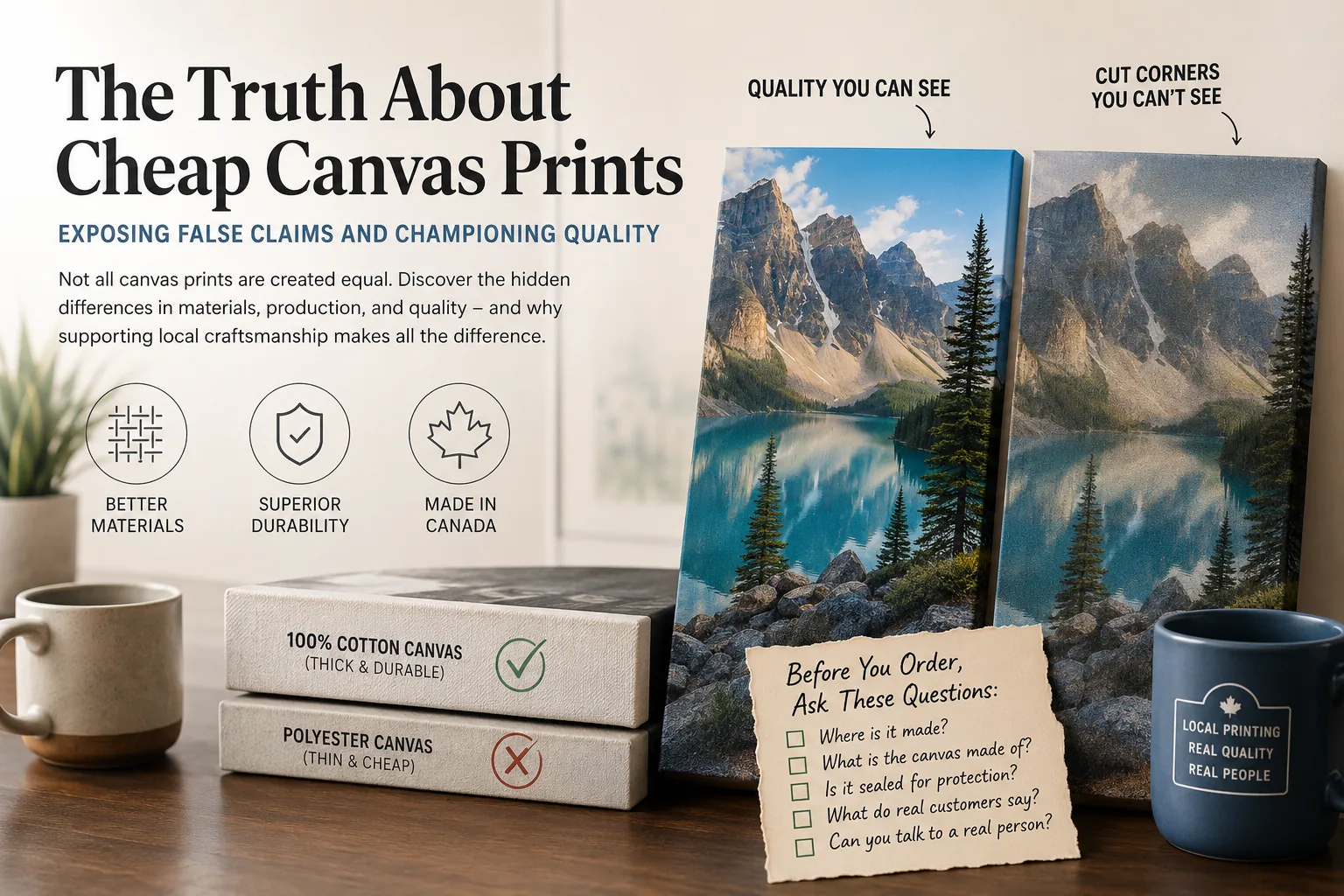
The canvas printing industry has changed dramatically over the past decade. What was once dominated by local print shops and professional photo labs is now crowded with companies promising huge discounts, “premium quality,” and Canadian-looking branding. Behind many of those claims, the reality can be very different.
Many consumers assume that if a website has a Canadian domain name, displays prices in Canadian dollars, and advertises heavily across Canada, the product must be Canadian-made. Many also assume that all canvas prints use similar materials and production methods.
Neither assumption is necessarily true.
Why Cheap Canvas Prints Look Better Online Than in Person
A canvas print is hard to judge before it arrives. Every company uses professionally photographed product images. Almost every website uses phrases such as museum quality, gallery wrapped, premium materials, fade resistant, and hand crafted.
The problem is that these terms do not have one consistent industry standard. A company printing on inexpensive synthetic canvas stretched over lightweight frames can use many of the same marketing phrases as a fine-art print shop using archival cotton canvas, pigment inks, hand stretching, and protective coatings.
To the average customer, the difference is not obvious until the box is opened. That is when disappointment starts.
The Hidden Difference: Cotton Canvas vs Polyester Canvas
The biggest difference between a premium canvas print and a budget canvas print often comes down to the canvas itself.
Traditional artist canvases have been made from cotton for centuries. Cotton canvas offers natural texture, rich ink absorption, better depth, and a genuine fine-art appearance. Polyester canvas is synthetic. It is cheaper to manufacture, easier to produce at high volume, and can look sharp in online product photos, but it often lacks the texture and character people expect from canvas artwork.
Many budget canvas companies use polyester or lower-cost poly-cotton blends because they reduce production costs. Customers often do not realize this because the material details are buried deep in product descriptions, described vaguely, or omitted entirely.
A Canadian-Looking Website Is Not Always Canadian-Made
This is one of the details that surprises Canadian buyers most. A .ca domain, Canadian-dollar pricing, and Canadian advertising do not automatically mean the company is Canadian-owned, locally operated, or producing orders in Canada.
BestCanvas.ca is a useful example of why consumers should look past the surface. Public domain and company-information sources have connected the brand with non-Canadian corporate structures, including Picanova Inc. in Ohio and United Arts GmbH in Germany. That does not mean every order is bad, and it does not mean there is anything wrong with an international business. It does mean buyers should verify where their order is physically produced before assuming they are supporting a Canadian print shop.
Customer-review sites also show a mixed picture: many satisfied buyers, alongside complaints about quality, shipping, communication, or order problems. The useful lesson is not “never order from a large company.” The useful lesson is to investigate beyond the marketing language.
CanvasChamp: Low Prices Have to Come From Somewhere
CanvasChamp is known for aggressive discounts and very low advertised prices. Those prices can look almost impossible, and there is usually a reason. The company’s own Canadian FAQ has stated that it ships from production facilities in the United States and India, and its material descriptions refer to blends rather than true 100% cotton canvas.
Again, this does not mean every customer has a poor experience. Large companies always generate mixed reviews. But if a canvas is being sold at a price that seems unusually low, it is fair to ask what changed: the material, the frame, the finishing, the labour, the quality control, or the customer support.
CanvasPop: Better Experience, But Still Check the Details
CanvasPop generally sits in a more polished part of the online canvas market. Their customer experience is often stronger than the deepest-discount providers, and their product pages emphasize archival, water-resistant, fade-resistant canvas.
But this is the exact point: words like archival, premium, and museum quality are not the same as a clear material specification. If you specifically want thick cotton canvas, ask whether the canvas is 100% cotton, cotton-rich, poly-cotton, or polyester. A better brand experience does not remove the need to verify the actual material.
Why Professional Print Shops Seal Their Canvas Prints
One of the least discussed differences in canvas printing is finishing. Many customers assume that once the image is printed, the canvas is finished. Professional printers know better.
After printing, premium canvas prints are typically coated with a protective finish. This layer can improve UV resistance, help protect against moisture and scratches, reduce fading, and enhance colour depth. Some high-volume production facilities skip or minimize this step because it adds labour, cost, and production time.
The result may still look acceptable on day one. The difference often becomes obvious years later.
Why Local Canvas Printing Still Matters
Online ordering is convenient. But convenience can create a disconnect between the customer and the people making the product. When production happens far away, communication becomes harder, problems take longer to solve, returns become more complicated, and quality control becomes less personal.
Local production gives you something simple but valuable: you know where your canvas is being made, who is making it, who to contact if something goes wrong, and that your money is supporting jobs in your own community.
What Canvas Prints Calgary Does Differently
At Canvas Prints Calgary, we built our business around a simple belief: a canvas print should feel like artwork.
That means using genuine premium materials, thick professional-grade cotton canvas, hand-stretching, protective coatings, and Canadian production. Could we lower our prices by switching to thinner polyester canvas or outsourcing production overseas? Absolutely. Many companies already do.
But that is not the product we want hanging in our own homes, and it is not the product we want delivering to our customers.
A Simple Checklist Before You Order Any Canvas Print
- Where is the canvas actually made?
Not where the website operates. Not where the domain is registered. Where is the product physically produced? - Is the canvas cotton, poly-cotton, or polyester?
If the company does not clearly tell you, ask. - Is the canvas sealed after printing?
A professional company should have a clear answer. - What do the lowest-rated reviews say?
Do not only read the five-star reviews. The one-star reviews often show you what happens when something goes wrong. - Can you contact a real person?
If there is a problem, will you be dealing with a local expert or a generic support system?
The Bottom Line
A canvas print is more than ink on fabric. It is often a wedding photograph, a family portrait, a once-in-a-lifetime vacation memory, or a piece of artwork that will hang on a wall for years.
When viewed that way, the cheapest option is not always the best value. The difference between a bargain canvas and a gallery-worthy canvas is not usually visible in a website advertisement. It is hidden in the materials, the craftsmanship, the finishing process, and the people behind the product.
The next time you see a canvas print advertised at an unbelievably low price, ask one simple question:
What had to be removed from the process to make that price possible?
The answer often tells you everything you need to know.
Sources and Further Reading
- CanvasChamp Canada FAQ for published material and shipping information.
- CanvasPop product specifications for its canvas product language.
- BestCanvas.ca Trustpilot reviews and other public review sources for current customer feedback.
- Archived BestCanvas email footer showing Picanova Inc. address information.